
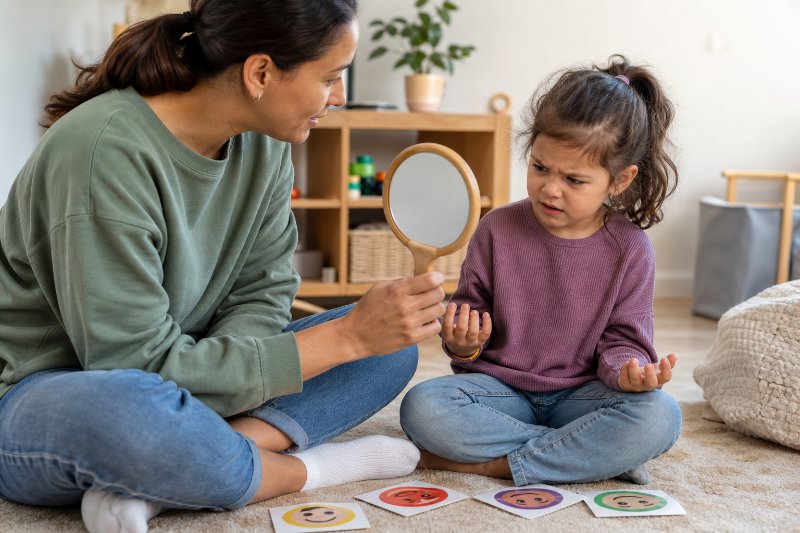
How to Build Emotional Vocabulary Before 5
Kelly Anderson
Your toddler points at the broken cracker and cries as if the whole morning has cracked with it. Your preschooler folds their arms, turns away, and says, “I’m not mad,” while every part of their small body says otherwise. In these moments, you may know exactly what is happening emotionally, yet your child may not have the words for it yet.
Feelings-based language gives young children a bridge between what they feel inside and what they can express outside. Before children can clearly say, “I felt left out when my friend ran away,” they may scream, hide, grab, or collapse into tears. Those behaviors are not always defiance. Often, they are early attempts at self-expression when the feeling is bigger than the vocabulary.
You do not need a formal lesson plan to help. The most powerful emotional learning often happens in tiny, repeated moments at home: during breakfast, in the car, at cleanup time, while reading bedtime stories, and after a hard goodbye. With gentle storytelling, responsive language, and steady connection, you can help your child begin to name big feelings without shame.
Why Feelings-Based Language Matters in Early Childhood
Young children experience strong emotions before they can fully explain them. A toddler can feel disappointment, jealousy, fear, pride, frustration, and relief, even if the only words available are “no,” “mine,” or “all done.” When you offer a feeling word, you are not putting words in your child’s mouth in a controlling way. You are lending language until they can carry it themselves.
Emotion words help children feel seen
When you say, “You look sad that the tower fell,” your child hears more than a label. They hear, “Someone noticed me.” That sense of being noticed can soften the intensity of a hard moment. It tells your child that feelings are not dangerous or too much for the relationship.
This is part of emotional safety. A child who feels emotionally safe does not have to hide every upset feeling or turn every disappointment into a power struggle. Over time, they can learn that anger can be named, sadness can be comforted, and worry can be shared.
Naming is only the beginning
It can be tempting to focus on teaching as many emotion words as possible, but depth matters too. Children benefit when they begin to understand what a feeling means, what may have caused it, and what they can do with it. Research on preschoolers suggests that a deeper understanding of emotion concepts, not only knowing many emotion words, may be especially important for emotion knowledge and behavior regulation, according to findings on emotion-specific vocabulary and preschool emotion regulation.
In everyday terms, this means “mad” is more useful when it is connected to a real experience. “You felt mad when your sister took the blue cup. You wanted a turn, and it felt unfair.” That simple sentence gives the feeling a name, a cause, and a place in the story.
Start With the Feelings Your Child Can Already Show
The easiest place to begin is not with a long list of emotions. Start with what your child already shows in their face, body, voice, and actions. Young children communicate through clenched fists, drooping shoulders, bright eyes, stomping feet, hiding behind your leg, or running toward you with open arms. These are the first clues.
Use simple words for visible feelings
For toddlers, begin with a small circle of familiar words: happy, sad, mad, scared, tired, proud, surprised, and disappointed. Preschoolers may be ready for more specific words like frustrated, nervous, lonely, embarrassed, excited, calm, jealous, or worried. The goal is not to quiz your child. The goal is to offer a word that fits the moment.
You might say, “Your face got very quiet. I wonder if you feel disappointed.” Or, “You jumped up and down when Grandpa came in. That looked excited.” Gentle phrases like “I wonder” and “maybe” are helpful because they leave room for your child to correct you. If they say, “No, mad,” you can respond, “You’re right. Mad fits better.”
Match the word to the body
Children often understand physical sensations before emotional concepts. You can connect the feeling to what their body is doing in a calm, respectful way. “Your hands are tight, and your voice is loud. That can happen when anger shows up.” Or, “You are holding my leg. Sometimes we hold on when we feel unsure.”
This kind of language helps your child notice signals inside their own body. It also keeps you from labeling them as a “mad kid” or a “shy kid.” The feeling is something passing through, not who they are.
Keep your tone steady and kind
Feelings-based language works best when your voice carries safety. If a child hears “You are angry” as criticism, they may push the word away. If they hear it as warmth, they are more likely to accept it.
You can speak slowly and simply: “You are really mad. I am here. I will not let you hit.” This gives two important messages at the same time. The feeling is allowed. The unsafe behavior is not.
Build Emotional Vocabulary Through Daily Conversation
Children learn emotional language through repetition, rhythm, and relationship. You do not need to wait for meltdowns. In fact, calm moments are often the easiest times to build understanding because your child’s brain is more ready to take in words.
Talk about your own everyday feelings
Your feelings can become gentle teaching moments when you describe them in child-friendly language. You might say, “I felt frustrated when I could not find the keys, so I took a breath and looked again.” Or, “I feel happy sitting with you while we read.”
These small comments show your child that emotions happen to everyone. They also show that feelings can be handled without being hidden or exploding outward. You are modeling emotional resilience in a way your child can see.
Connect feelings to causes without blame
A useful feelings sentence often has three parts: the feeling, the reason, and the need. You do not need to present it as a formula. Just let it flow naturally. “You felt worried when the dog barked because it was loud. You needed to be close to me.”
This helps children understand that emotions have stories behind them. A preschooler who hears this often may eventually say, “I’m sad because I wanted Daddy,” or “I’m mad because I wasn’t done.” Those sentences are early signs of emotional learning taking root.
Ask gentle questions, not performance questions
Some children love answering, “How do you feel?” Others freeze or say “I don’t know.” If direct questions feel too big, try offering choices. “Are you feeling mad, or more sad?” You can also use observation. “Something feels hard right now. I’m going to stay close.”
Responsive interaction matters. Research on parental responsiveness and preschoolers’ emotional understanding found a direct association between positive parental responsiveness and children’s emotional understanding, through expressive language and related skills, as described in this study on responsive parenting and emotional understanding. In daily life, responsiveness can look like pausing, listening, reflecting, and staying emotionally available while your child searches for words.
Use Storybooks as Safe Practice for Big Feelings
Stories give children emotional distance. It may be hard for a child to talk about their own anger, but easier to talk about a bear who stomps or a zebra who feels left out. A book creates a shared space where the feeling belongs to the character first. That can feel safer.
Pause to name what characters might feel
During shared reading, you can slow down at emotional turning points. “Look at her face. What do you think she feels?” If your child does not answer, you can gently offer language. “Maybe she feels lonely because no one saved her a seat.”
Keep these pauses brief. The story should still feel like a story, not a test. Children often learn best when the conversation feels warm and connected. You can return to the plot, the pictures, and the comfort of your voice.
Use books after hard moments
If your child had a difficult goodbye at preschool, a book about missing someone can help later in the day. If bedtime has become full of worry, a gentle bedtime story about feeling safe can give your child words without placing them in the spotlight.
Research on shared book reading and journaling with preschoolers found that interactive book reading and journaling activities had positive effects on emotion regulation skills, according to research on shared reading, journaling, and preschool emotion regulation. For home use, this can be as simple as reading together, pausing for feeling words, and inviting your child to draw or talk afterward if they want to.
Let repeated stories do quiet work
Parents sometimes wonder why children ask for the same book again and again. Repetition can be comforting. It also gives emotional language more chances to settle in. The first time, your child may notice the bright picture. The fifth time, they may notice the character’s tears. The tenth time, they may whisper, “He’s scared.”
If you are looking for gentle picture books designed around emotional learning, self-expression, and parent-child connection, the Zebra Baby emotional learning picture book series offers stories for ages 2 to 6 that help children feel safe, confident, and understood.
Bring Feeling Words Into Everyday Home Routines
Feelings-based language becomes most useful when it belongs to ordinary life. You do not have to create a special emotion lesson. You can weave words into the places your child already knows: the breakfast table, the car seat, the bathtub, the sidewalk, and the bedroom lamp glow before sleep.
Morning moments can name anticipation
Mornings often carry many feelings at once. Your child may feel excited for play, sad about separation, annoyed by socks, or nervous about a new classroom activity. You can make space for that mix without slowing the whole morning to a stop.
Try language like, “Part of you wants to stay home, and part of you wants to see your friend. That is a lot of feelings.” This helps your child understand that feelings can overlap. They do not have to choose only one.
Transitions can include emotional preparation
Young children often struggle when one activity ends and another begins. Rather than saying only, “It’s time to go,” add a feeling word. “It is hard to stop playing when you are having fun.” Then add the boundary. “We are leaving the park now, and you can feel sad with me.”
This does not mean your child will calmly agree every time. Feelings-based language is not a magic switch. It is a relationship practice. Even when the tears continue, your child is hearing that their inner experience makes sense.
Mealtimes can teach preference and disappointment
Food often brings strong reactions. A child may be disappointed by the wrong cup, suspicious of a new texture, or proud of pouring water. These small moments are rich with language.
You might say, “You were hoping for the dinosaur plate. You feel disappointed.” Or, “You tried a crunchy carrot and looked proud.” When children hear words for everyday emotional shifts, feelings become normal rather than alarming.
Bedtime can soften worries
Bedtime is a natural time for big feelings to rise. The room gets quiet. The day slows down. A child who seemed cheerful at dinner may suddenly need one more hug, one more sip, one more answer about tomorrow.
You can use a calming phrase that becomes familiar over time: “Your body is tired, and your thoughts are busy. Sometimes that feels like worry.” Then offer connection. “I am close. You are safe in your bed.” Bedtime stories can support this rhythm, especially when characters move through fear, sadness, or uncertainty and find comfort.
Disclaimer: Zebra Baby content is created for educational and storytelling purposes only and is not a substitute for professional medical, mental health, or therapeutic advice.
Related Articles
Social Emotional Learning Books vs. Stories
Stories can give young children the words for big feelings, turning tears, fear, and frustration into naming, calming, and repair. In Portland, social emotional learning books are most useful when they make emotional practice feel safe and familiar.
Welcome to the Zebra Baby Blog
A gentle hello from Kelly: why these stories exist, and how to use them when big feelings show up at home.
Parenting Resources for Portland by 6 Weeks
Portland families can use simple supports at home, from school readiness and literacy tools to bedtime stories that build emotional language. The biggest payoff is calmer routines and a child who can start naming big feelings instead of acting them out.