
How to Help a Child With Big Emotions: 10 Parent Tips
Kelly Anderson
Some days, you can make room for your child’s tears. Other days, the shouting, clinging, or sudden refusal leaves you feeling stretched thin. You may understand that your child is overwhelmed and still wonder what to do when dinner needs cooking, a sibling needs attention, and everyone is tired.
Helping a child with big emotions does not mean making every feeling disappear. Your goal is to keep everyone safe, offer support, and teach skills your child can gradually use with less help. These ten approaches give you options, not a test to pass. Choose what fits your child and your capacity today.
Start With Safety and Your Own Response
Before you decide what lesson to teach, consider what support the moment needs. Safety and connection can come first without giving up your boundaries.
Pause before you add your own intensity
Give yourself a small pause before responding. Feel your feet against the floor, loosen your hands, and lower your voice. You do not need to feel completely calm to respond with care.
A 2026 longitudinal study on mindful parenting and children’s emotional regulation found a small association between mindful parenting and lower subsequent child irritability. It did not establish that mindful parenting caused the difference. Treat your pause as a useful practice, not a promise that your child will settle immediately.
If you need a brief break, make sure your child is safely supervised first.
Look for the need beneath the behavior
Ask yourself, “What might be making this hard?” Consider hunger, fatigue, noise, an unexpected change, or a task your child cannot yet manage independently. You can investigate without assuming you know the answer.
Indiana University’s guidance on challenging behavior in early childhood encourages viewing behavior as communication and describes identifying feelings, communicating needs, and calming the body as skills children must learn.
That perspective changes your question from “How do I stop this?” to “What support and boundary are needed here?” Understanding a need does not require agreeing to every request.
Make the space safer and less demanding
If your child is throwing objects, move breakable items and give siblings some distance. If a crowded room seems overwhelming, offer a quieter spot where you can stay nearby. Keep your movements predictable and your directions brief.
A quiet space should be an offer of support, not a punishment for having feelings. You might sit beside a cushion or leave room for your child to stand. Avoid insisting on eye contact, a hug, or a particular posture. Unless immediate safety requires action, give your child some control over physical closeness.
Accept the Feeling While Holding the Limit
Emotional safety and firm boundaries belong together. Your child can be furious about a limit while you continue to hold it with care.
Name the feeling without deciding it for them
Offer a simple guess: “You seem frustrated that the pieces won’t fit.” Then leave space for your child to disagree, stay quiet, or use a different word. You are offering language, not demanding an explanation.
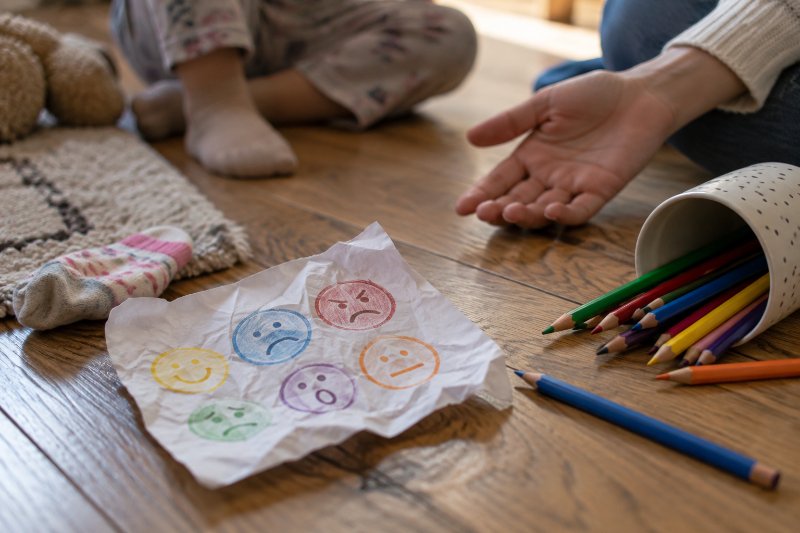
For a child who uses few words, try pointing to a simple face drawing or offering two possibilities: “Sad or mad?” There is no need to get the label exactly right. Your attentive response matters more than a vocabulary lesson. Save detailed questions for a time when your child can comfortably engage.
Separate what is allowed from what is not
Make the boundary about behavior rather than the emotion: “You can be angry. I won’t let you hit.” Move out of reach or separate children as needed, using the least physical intervention necessary for immediate safety.
Keep the limit steady without repeating a long explanation. If the answer is no to buying a toy, acknowledging the sadness does not turn that no into a yes. You can care about the disappointment and still leave the store. Later, supporting your child through disappointment can include practicing how to ask for comfort when an answer hurts.
Offer a small choice instead of another demand
When there is room for choice, offer two options you can genuinely accept: “Would you like me beside you or by the doorway?” Both options preserve support while giving your child a say.
Avoid making calmness the requirement for receiving care. You can stay available even if your child cannot choose. Simply say, “I’ll sit here for now.” If a task must happen, keep the choice within that boundary: “Would you like to carry your shoes or have me carry them?” Leave out choices when an immediate safety issue needs your direct action.
Practice Emotional Skills Outside the Hardest Moments
You do not have to turn every upset into a teaching opportunity. Set aside ordinary, low-pressure moments for emotional learning instead.
Build a small menu of comfort options
Invite your child to try a few simple supports while they feel comfortable: holding a soft toy, stretching, sipping water, sitting near you, or slowly blowing an imaginary candle. Notice what they prefer rather than selecting a technique because it sounds effective.
You can draw pictures of two or three options and keep them somewhere accessible. During a difficult moment, offer one familiar choice rather than presenting the whole menu. If breathing exercises frustrate your child, leave them out. The purpose is to find usable support, not to require a performance of calmness.
Rehearse expressing a need through play and stories
Let a stuffed animal need help, want a turn, or feel worried about joining a game. Ask your child what the animal could do. Offer practical language such as “Help, please,” “More space,” or “Can I have a turn next?”
Bedtime stories offer another gentle invitation. Pause at a character’s difficult moment and wonder aloud about what support might help. Keep participation optional, and let the story remain enjoyable. For a child who communicates through gestures, pictures, or a communication device, include those ways of asking, too. Self-expression does not have to be spoken.
Strengthen Connection Beyond the Outburst
What happens between difficult moments deserves attention, too. You can adjust daily demands and reconnect afterward without making big feelings the center of family life.
Look for patterns and adjust one pressure point
Make a brief note of what tends to happen before a hard moment. Was there a missed snack, a rushed departure, or a noisy activity? Look for recurring circumstances rather than keeping a score of your child’s behavior.
Choose one manageable adjustment, such as offering a snack before errands or leaving more space between activities. Ask other caregivers what they notice, too. You may not find a clear pattern, and an adjustment may not prevent every upset. The aim is to make daily life more workable, not to arrange a world without frustration.
Reconnect, repair, and notice specific efforts
Once everyone is settled, keep the conversation brief. Describe what happened without labels: “You threw the blocks when the tower fell.” Then discuss a possible alternative and include repair, such as helping pick them up.
If you shouted, take responsibility without blaming your child: “My voice was too loud. That was my responsibility. Next time, I’ll pause.” You do not need to apologize for a reasonable limit.
Notice small efforts specifically: “You asked me for help when that felt hard.” This keeps your attention on a skill your child practiced, not on whether they stopped crying quickly.
Know When Your Family Needs More Support
Consider talking with your pediatrician if emotional episodes regularly interfere with sleep, eating, preschool, friendships, or family activities. Seek advice about frequent aggression, self-injury, a sudden behavior change, or loss of previously learned skills. You can also ask for help simply because you feel overwhelmed.
Share what happens, what comes before it, and what you have already tried. A pediatrician can help assess possible contributing factors and recommend appropriate support. If anyone is in immediate danger, prioritize safety and contact emergency services.
Keep the Goal Connection, Not Constant Calm
You are helping your child learn that feelings can be intense without making them unacceptable or alone. Start with one response you can repeat: a pause, a clear boundary, or a familiar comfort option. Progress can include asking for help or reconnecting after conflict, even when tears remain.
A shared story can give you a gentle place to return to these ideas. Explore Zebra Baby’s emotional learning books and resources, with warm storytelling that supports feeling safe, understood, confident, and proud of who you are. You can also browse the Zebra Baby paperback series on Amazon for a story that reflects the feelings your child is learning to express.
Sources
Disclaimer: Zebra Baby content is created for educational and storytelling purposes only and is not a substitute for professional medical, mental health, or therapeutic advice.
Related Articles

Sharing vs. Taking Turns: What Toddlers Need to Learn
Clear requests help toddlers build generosity and boundaries: sharing can mean using an item together or offering part, while taking turns means each child gets separate time with it.

How to Choose Emotionally Supportive Bedtime Stories for Kids in Portland
Portland bedtime stories for kids work best when emotionally safe characters face relatable challenges, giving families room for calm conversations that help settle lingering feelings.
Best Books to Read to Toddlers that Build Language Skills
The best books to read to toddlers match their attention span, invite active participation, and feel emotionally safe, because simple favorites read again and again build language, confidence, and connection.