
Sharing vs. Taking Turns: What Toddlers Need to Learn
Kelly Anderson
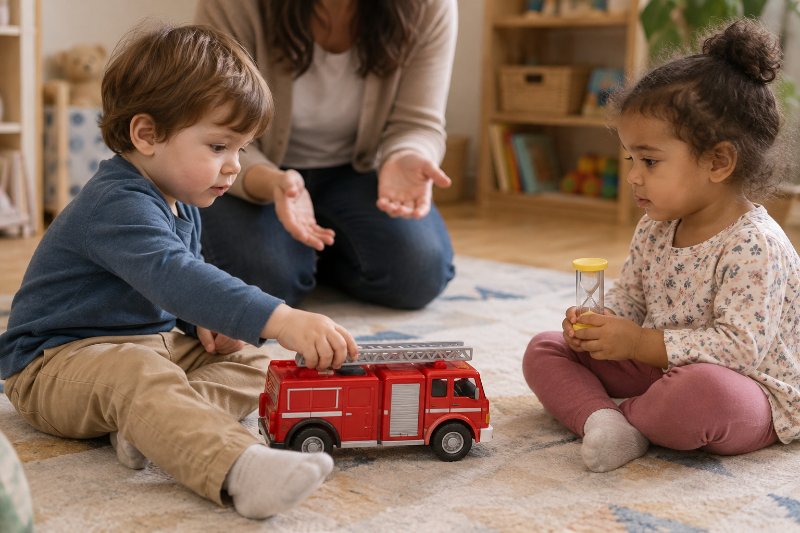
“Please share” sounds like a simple request. But what does it mean when your toddler is holding the only toy fire truck? Give it away? Play together? Stop playing because someone else wants it?
Before you can teach the skill, it helps to make the request clearer. Sharing and taking turns are closely connected, but they are not always the same action. Sharing can mean using something together or offering part of what you have. Taking turns means one person uses something, then another person gets a turn.
You do not have to choose between raising a generous child and respecting your toddler’s play. You can teach both consideration and boundaries, using clear words that explain what happens next.
What Sharing and Taking Turns Actually Mean
For everyday parenting, it helps to distinguish three situations: using something together, giving someone a portion, and using something at different times. Each calls for a slightly different request.
Sharing can mean enjoying something together
A large tub of blocks can support shared play. Your child builds a garage while another child builds a tower. Neither child needs to surrender the entire activity.
Sharing can also mean offering part of something, such as giving another child a sheet from a stack of stickers. That is different from lending a toy because the offered portion might not come back. You can make your meaning specific: “Would you like to offer Sam a sticker?” rather than simply saying, “Share.”
Taking turns gives each person separate access
With one ride-on car, simultaneous use may not be possible. Taking turns answers a practical question: who uses it now, and who uses it next?
These are connected skills, not competing approaches. Children’s Wisconsin recommends modeling sharing through concrete turn-taking rather than treating sharing as an abstract idea. Your words can reflect that: “You’re riding now. After your turn, Maya will ride.”
The useful distinction is not “sharing is bad, taking turns is good.” It is whether your request clearly describes what you want your child to do.
Why “Just Share” Can Be a Big Request
According to First Things First’s guidance on helping toddlers share, toddlers are still learning to manage big feelings, wait their turn, and understand other people’s needs. Sharing asks them to practice several developing abilities at once.
You can therefore treat a disagreement as a teaching moment rather than a verdict on your child’s character. “Mine!” does not require you to label your child selfish. It gives you an opportunity to explain whose object it is, who is using it, and what the boundary will be.
Keep kindness separate from immediate surrender
Consider the message you want to teach: another person’s wishes matter, and your child’s ongoing play matters too. You can acknowledge both without making either child responsible for removing the other’s disappointment.
Try: “You’re still working on your road. Alex wants the roller. You can tell Alex, ‘I’m using it.’” Then support the waiting child: “You wanted that roller. I’ll help you find something to do while you wait.”
For personal belongings, you can allow some choice about lending. For shared equipment, you can set reasonable limits so everyone has access. Respecting a current turn does not require allowing one child to keep a community toy indefinitely.
Match the Boundary to the Toy and the Setting
Before deciding what to say, ask yourself whether the object belongs to your child, belongs to someone else, or is available for everyone. That distinction can guide your response more usefully than repeating the same sharing rule everywhere.
Personal toys can have protected boundaries
Before a playdate, invite your child to put away a few treasured possessions. You might say, “Your special bunny can stay in your room. Let’s choose toys for playing together.”
You can also decide that certain belongings, such as a comfort object, are not available for turns. Explain that boundary to visitors without apologizing for it: “That bunny stays with Jordan. These animals are for everyone to play with.”
This does not remove opportunities for generosity. You can still invite your child to offer a different toy, make space beside them, or choose an activity to enjoy together.
Community toys need shared-access rules
At a playground, library, or toddler group, follow the setting’s rules and establish a manageable turn. “Two more trips down the ramp, then it’s Casey’s turn” gives a clear endpoint when other children are waiting.
A timer is another option, not a requirement. If you use one, explain it before starting: “When it rings, this turn ends.” Avoid presenting the timer as something that will make disappointment disappear. You may still need to support a tearful handoff.
A grabbed toy needs a calm response
If your child takes something another child is using, move close and help return it gently. You can say, “Taylor was using that. I won’t let you pull it away. You can ask for a turn.”
If your child’s toy is grabbed, offer the same protection. The boundary should not depend on which child protests more loudly. Aim to protect the current user while helping the waiting child, rather than rewarding grabbing or demanding an instant handoff.
Teach the Words and Support the Waiting
You can make turn-taking practice manageable by keeping your language short and your help practical. During a disagreement, choose one clear boundary instead of a long explanation about fairness.
Give both children something useful to say
The child holding the toy might need “I’m using it” or “You can have it next.” The waiting child might need “Can I have a turn?” or “Please tell me when you’re done.”
If your child is not using those words yet, you can speak for them without requiring repetition. Accept a gesture or a supported handoff as participation. The aim is communication, not a rehearsed performance.
You can also practice naming feelings in ordinary moments. During a toy disagreement, offer a brief description: “You’re disappointed. You wanted it now.” Then keep the limit separate: “It’s still Avery’s turn.”
Make waiting supported, not empty
Offer company and a real alternative: “You can sit beside me or use this shovel while you wait.” If your child declines both, you can acknowledge that without changing the boundary.
Avoid promising a turn you cannot provide. If another family is leaving with their own toy, say, “That truck is going home with them.” Honest limits are more useful than “Maybe later” when later is not an option.
If hitting or pushing begins, focus on safety. Gently block the action or create space, saying, “I won’t let you hit.” You can return to practicing requests after everyone is safe and your child is ready to engage.
Practice outside the conflict
Look for brief, low-pressure opportunities: alternate adding blocks to a tower, take turns making animal sounds, or pass a toy back and forth when your child is interested. You can model the language yourself: “Your turn. Now my turn.”
Notice the action rather than assigning a label. “You passed the scoop when your turn ended” is more specific than “You’re good at sharing.” You can recognize effort even when it includes frustration: “Waiting was hard, and you kept your hands safe.”
Make Fairness Clear, Not Forced
The difference between sharing and taking turns for toddlers is mostly about making expectations understandable. Sharing may involve playing together or offering a portion. Turn-taking provides a clear arrangement for using something separately.
You can protect personal belongings, set limits around community toys, and support disappointment without treating every protest as a failure. Your goal is not a cheerful handoff every time. It is repeated practice with consideration, communication, and respectful boundaries.
The feelings behind “my turn” can have a place in storytime, too. Explore Zebra Baby’s emotional learning books and resources for warm storytelling that helps children feel safe, confident, emotionally understood, and proud of who they are. You can also browse the Zebra Baby paperback series on Amazon and choose a story that speaks to the feelings your child is learning to express.
Sources
Disclaimer: Zebra Baby content is created for educational and storytelling purposes only and is not a substitute for professional medical, mental health, or therapeutic advice.
Related Articles
How to Choose Emotionally Supportive Bedtime Stories for Kids in Portland
Portland bedtime stories for kids work best when emotionally safe characters face relatable challenges, giving families room for calm conversations that help settle lingering feelings.
Best Books to Read to Toddlers that Build Language Skills
The best books to read to toddlers match their attention span, invite active participation, and feel emotionally safe, because simple favorites read again and again build language, confidence, and connection.
How Social Emotional Learning Books Help: An Honest FAQ
Social-emotional learning books build emotional skills through repeated reading, play, and supportive conversation, not as stand-alone behavior fixes. Progress often appears gradually in words, choices, and connection.