
How to Extend Storytime: Emotional Learning
Kelly Anderson
Reading an emotional learning book with a young child can feel like a quiet, meaningful moment: a child curled beside you, a page turned slowly, a character feeling worried, angry, shy, proud, or brave. But the learning does not have to stop when the cover closes. For many children, the best part comes afterward. They act out the story with stuffed animals. They ask why the character cried. They draw the “mad face” again and again. They bring the same feeling into block play, bath time, or the walk to school. These moments are not random. They are how children practice emotional learning in the language they know best, play. You do not need a formal lesson plan to help a story become part of your child’s emotional world. You need curiosity, patience, and a few simple ways to invite self-expression. Whether you are a parent reading at bedtime or an educator sharing a picture book in a preschool classroom, the right follow-up can help children feel safe, understood, and more confident with big feelings.
After the Last Page: Why the Conversation Matters
An emotional learning book gives children a safe place to meet feelings that may be too large or confusing in real life. A character can feel jealous, scared, disappointed, or left out, and your child can watch from a comfortable distance. That distance matters. It lets children think, wonder, and make meaning without feeling put on the spot. When you talk or play after reading, you are helping the child connect the story to real emotional skills. They begin to notice that feelings have names, bodies give clues, choices matter, and caring adults can help. The goal is not to make every child speak deeply about emotions right away. Some children talk. Some move. Some build. Some sit quietly and return to the idea later.
Let the book be a bridge, not a lecture
After reading, it can be tempting to explain the lesson right away. “See, that is why you should share,” or “That is why yelling hurts feelings.” Those messages may be true, but young children often learn more when they are invited into the story gently. You might say, “That was a big feeling on that page,” and pause. Or, “I wonder what helped the character feel safe again.” These softer openings create emotional safety. They tell your child that feelings are welcome, not something to rush through or correct.
Watch for the feeling your child notices first
Adults often focus on the moral of a story. Children may focus on something else entirely, the sad face, the missing toy, the dark room, or the hug at the end. That detail is useful. It shows you which part of the story touched their inner world. If your child keeps pointing to one picture, stay there. If they want to reread one page, let it matter. Repetition is not a problem. In early childhood, repetition helps children feel secure enough to understand more each time.
Discussion Prompts That Feel Natural, Not Like a Quiz
The best questions after an emotional learning book feel like conversation, not testing. A child should not feel that there is one correct answer. Feelings are personal, and stories give children room to practice noticing, naming, and wondering.
Start with what they see
Observation questions are easy entry points because they do not require a child to explain their own feelings right away. You might ask, “What do you notice about the character’s face?” or “What is happening with their hands?” You can also wonder aloud, “Their shoulders look tight to me. I wonder if their body is showing a worried feeling.” These small comments teach children that emotions often show up in bodies before words. Over time, this helps them recognize their own cues, such as a tight belly, loud voice, curled fists, or wanting to hide.
Invite imagination before personal sharing
Some children love talking about themselves. Others feel safer talking about a character, animal, or pretend friend. Instead of asking, “Do you feel that way?” try, “What do you think the character wanted someone to understand?” or “If their teddy bear could talk, what might it say?” This keeps the conversation gentle. A child may still connect the story to their own life, but they get to choose when and how.
Use prompts that support problem-solving
Emotional learning is not only about naming feelings. It is also about practicing what to do with them. After reading, you can ask, “What helped the character calm down?” or “Who was kind in this story?” or “What else could the character try next time?” If your child gives an answer that seems silly, stay open. “The character could fly to the moon” may not be realistic, but it may mean, “They wanted to get away.” You can respond with warmth: “Sometimes when feelings are huge, getting space sounds really good.”
Creative Activities That Help Feelings Become Concrete
Young children learn through their senses. When a feeling becomes something they can draw, move, hold, or build, it becomes easier to understand. These activities work well after reading, during quiet afternoons, in classrooms, or as part of a bedtime stories routine when your child still has energy to process the story.
Make feeling faces with a mirror
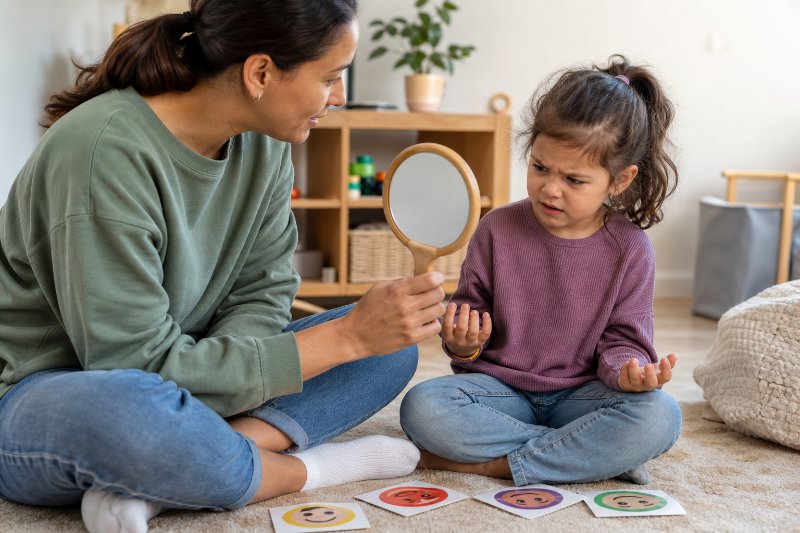
Sit near a mirror and invite your child to make the face the character made in the book. Try sad, surprised, frustrated, proud, calm, and brave. Keep it playful and respectful. You are not asking your child to perform on command. You are helping them notice how faces change. You can join in too. Say, “This is my worried face. My eyebrows go up, and my mouth gets small.” Then soften your face and say, “This is my calm face after I take a slow breath.” Children often enjoy seeing adults model emotions in a safe, reassuring way.
Create a color map of the story
Offer crayons or markers and ask, “What color was the feeling at the beginning of the story?” Then ask what color the feeling became later. A child might choose red for anger, blue for sadness, yellow for pride, or purple simply because purple feels right. There is no need to correct the color choice. The purpose is self-expression. You can say, “Tell me about this red part,” or “This green looks very calm.” Children who do not yet have many feeling words may express a great deal through color, shape, and pressure on the page.
Build a calm-down corner for the character
Using blocks, pillows, scarves, or a small box, invite your child to make a safe place for the character. Ask what the character might need there. A blanket? A stuffed animal? A quiet sign? A picture of someone they love? This activity teaches a powerful idea: when feelings are big, comfort can be planned. Children begin to understand that needing support is normal. You can later connect it gently to your child’s world by saying, “Your calm place has books and your soft bear. The character might like that too.”
Play-Based Extensions for Deeper Emotional Learning
Play gives children a way to rehearse life. After an emotional learning book, pretend play can help them practice empathy, problem-solving, and resilience without pressure.
Use puppets to retell the feeling
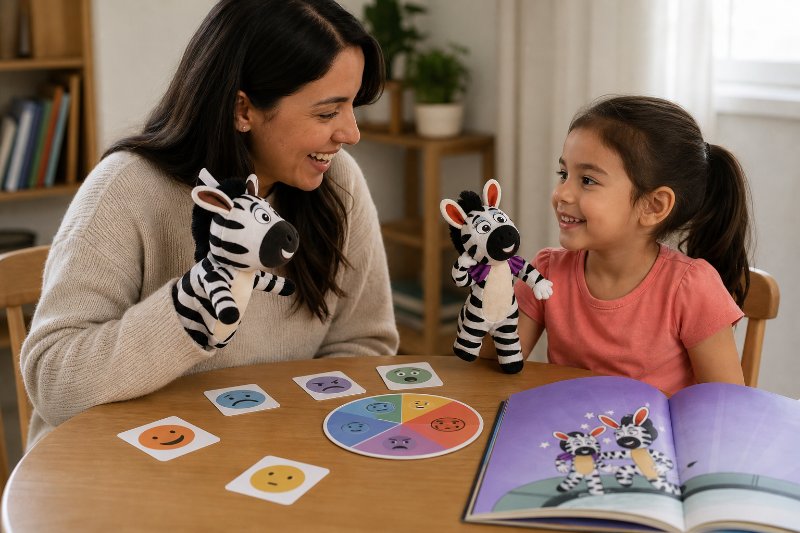
You do not need fancy puppets. Socks, paper bags, wooden spoons, or stuffed animals work beautifully. Let one puppet be the character and another be a helper. The helper does not have to solve everything. Sometimes the helper can simply say, “I am here,” or “That felt hard.” This kind of gentle storytelling helps children hear caring language. Later, those words may become part of how they comfort a friend, sibling, or themselves.
Turn movement into emotional practice
Some children need to move before they can talk. Invite them to show how the character walked when feeling mad, how they curled up when feeling shy, or how they stood tall when feeling confident. Then add a calming movement, such as stretching arms wide, swaying slowly, or pretending to blow bubbles. Movement helps children connect emotions to the body. It also gives energetic children a way to participate fully, especially in group settings.
Set up a story repair station
A “repair station” is a pretend place where characters can bring hurt feelings, broken friendships, or confusing moments. Use paper hearts, bandage stickers, blocks, or small baskets. Ask, “What needs care in this story?” Your child may place a paper heart near the character who felt left out or build a bridge between two figures. This is not about forcing apologies. It is about helping children see that relationships can be cared for. Repair is a key part of resilience and parent-child connection.
Zebra Baby Books emotional learning series
Disclaimer: Zebra Baby content is created for educational and storytelling purposes only and is not a substitute for professional medical, mental health, or therapeutic advice.
Related Articles
How to Build Emotional Vocabulary Before 5
Simple, repeated moments at home, during meals, cleanup, or bedtime, give young children the words for big feelings before those feelings turn into tears, grabbing, or shutdowns.
Social Emotional Learning Books vs. Stories
Stories can give young children the words for big feelings, turning tears, fear, and frustration into naming, calming, and repair. In Portland, social emotional learning books are most useful when they make emotional practice feel safe and familiar.
Bedtime Stories Teach Emotional Regulation
Bedtime stories work best when one clear feeling takes center stage, like worry, anger, or sadness. The right children's books make big emotions easier to name and discuss, without overwhelming a child at the end of the day.