

Why Stories Teach Empathy Best in Kids
Kelly Anderson
A child hears, “Be kind,” and may understand the words. But when that same child hears about a character who feels left out at the lunch table, watches another child hesitate, then offer a seat, something deeper begins to happen. The child is not only receiving a rule. Your child is stepping into a small emotional world. That is the quiet strength of narrative storytelling. Stories give children room to feel before they are asked to act. They can notice a frown, wonder why someone is upset, feel worry when a character is scared, and feel relief when repair begins. For young children, especially in early childhood, that emotional practice can be more meaningful than a lecture because it works with the way their brains are growing. Direct instruction still matters. Children need clear limits, family values, and simple guidance. Yet empathy rarely grows from commands alone. Empathy grows when a child has repeated chances to imagine, reflect, and connect. A story creates emotional safety around big feelings, allowing your child to practice compassion without being the one in trouble.
Why Stories Reach Children Before Lessons Do
Young children learn through experience, relationship, repetition, and play. A direct lesson often asks them to step back from their feelings and think abstractly: “How would you feel if someone did that to you?” That can be useful, but it also asks a lot from a developing brain. A story lowers the pressure. Instead of feeling accused, your child can look at a character and think, “That bunny is mad,” or “That girl feels lonely.” The emotional distance makes reflection safer. Your child does not have to defend their own behavior. They can observe, wonder, and slowly connect the character’s experience to real life.
The protective power of “not me, but near me”
Stories create a space that is close enough to feel real, but far enough away to feel safe. This matters because shame can shut learning down. If a child hears, “You were unkind,” the body may respond with embarrassment, resistance, or tears. If that same child hears about a character who grabs a toy and then notices another character crying, the child can stay curious. That safe distance supports emotional learning. Your child can think about jealousy, fear, anger, exclusion, and repair without feeling exposed. Over time, the character becomes a gentle mirror. Your child may begin to recognize, “Sometimes I feel that way too.”
Stories invite participation instead of performance
Direct instruction often has a right answer. A parent asks, “Was that kind?” and a child knows what they are supposed to say. Storytelling gives more room for real thought. You might ask, “What do you think she wanted?” or “Why did he hide under the blanket?” These questions invite your child into the emotional meaning of the moment. This kind of participation matters. A study in Frontiers in Psychology on narrative participation and emotion comprehension reported that children in the intervention group showed larger gains than children in the control group, with a substantial effect size, when stories were used as a context for meaning-making around emotions, according to the Frontiers in Psychology study on narrative participation and emotion comprehension. In plain language, children benefited when they did more than listen passively. They made meaning with the story.
What Is Happening in the Developing Brain
Empathy is not one single skill. It is a blend of noticing feelings, understanding another person’s point of view, caring about what they feel, and choosing a helpful response. For young children, those abilities are still under construction. A toddler may comfort a crying sibling one moment and push them away the next. A preschooler may understand sadness in a story but still struggle to pause when angry. This is not failure. It is development. The brain systems involved in impulse control, perspective-taking, language, memory, and emotional regulation are still growing and learning to work together.
Stories connect feeling and thinking
When your child listens to a story, several kinds of processing happen at once. They hear language. They follow events. They look at pictures. They listen to your tone. They track what a character wants, what goes wrong, and how others respond. This gives the brain a rich pattern to work with. A simple command, such as “Share,” can be clear but thin. A story gives context. A character loves a red truck. Another character wants a turn. The first character feels tight in the chest and says no. The second character’s face falls. A caring adult helps them find a way forward. Now your child can feel the tug of both sides. That is empathy practice. Your child is not just memorizing a rule. Your child is rehearsing how feelings move through a situation.
Perspective-taking grows through character minds
A young child’s world naturally begins with the self. That is developmentally normal. Stories gently stretch that center outward. They ask, “What does this character know? What does this character want? What did this character misunderstand?” This is powerful because empathy depends on perspective-taking. Your child begins to see that two people can experience the same moment differently. One child may think a game is funny. Another may feel embarrassed. One character may seem mean at first, then turn out to be scared. Stories make these hidden inner worlds visible. Picture books are especially helpful because illustrations show emotional clues that young children can read before they can fully explain them. A slumped body, a turned-away face, wide eyes, or clenched hands gives your child a concrete place to begin.
Repetition strengthens emotional patterns
Children often ask for the same story again and again. That repetition can feel tiring to you, especially at bedtime, but it serves a purpose. Each reading gives your child another chance to predict, feel, and understand. The story becomes familiar enough that your child can focus on deeper emotional details. On the first reading, your child may notice what happened. On the next, your child may notice how someone felt. Later, your child may notice why an apology mattered. This repeated emotional rehearsal helps build confidence with big feelings. A PLOS ONE study on bedtime reading reported significant improvements in cognitive empathy, total empathy, creative fluency, and creative originality among both groups studied, according to the PLOS ONE study on daily bedtime reading, empathy, and creativity. The key takeaway for parents is encouraging: daily story rituals can be more than pleasant routines. They can become meaningful practice for emotional growth.
Why Direct Instruction Can Fall Short With Empathy
Direct instruction is often necessary for safety and boundaries. You may need to say, “Hands are not for hitting,” or “Stop, that hurts.” Clear guidance protects children and teaches family expectations. But empathy is different from obedience. A child can follow a rule without understanding another person’s experience. A child can say “sorry” without feeling repair. The goal is not only to produce polite words. The deeper goal is to help your child recognize feelings, care about impact, and trust that relationships can mend.
Rules tell children what to do, stories help them understand why
A rule can guide behavior quickly. A story can build meaning slowly. When your child hears about a character who feels invisible until someone notices them, kindness becomes more than a rule. It becomes an emotional experience. That emotional experience helps values take root. Children are more likely to remember a lesson when it is tied to a feeling, a relationship, and a vivid image. “Include others” may fade. The memory of a character standing alone by the swings may stay.
Lectures can overload a child who is already upset
Many empathy lessons happen right after conflict. One child has grabbed, shouted, refused, or melted down. You want to teach right away because the moment feels important. But a dysregulated child may not be ready for reflection. When children are flooded by big feelings, their ability to listen, reason, and consider another person is limited. This is why a long lecture during a meltdown often goes nowhere. The child may hear your tone more than your words. Stories allow you to teach outside the heat of the moment. Later, when your child is calm, you can read about a character who felt angry and made a choice. The lesson lands more gently because your child’s nervous system is not in alarm mode.
Empathy needs practice, not pressure
You cannot force a child to feel empathy on command. You can invite it, model it, and give it many chances to grow. Storytelling does this beautifully because it allows practice without pressure. A child can try on many emotional roles through stories: the one who feels left out, the one who makes a mistake, the one who repairs harm, the one who needs courage, the one who offers comfort. Over time, this broadens your child’s emotional imagination.
How Parents Can Use Storytelling to Support Empathy
You do not need to turn storytime into a lesson plan. In fact, it often works best when it feels warm, relaxed, and connected. Your presence is part of the teaching. Your voice, pauses, facial expressions, and openness all help your child feel safe enough to think and talk.
Pause where the feelings are
The richest empathy moments often happen before the problem is solved. When a character looks worried, pauses at a doorway, hides a drawing, refuses to share, or says something hurtful, slow down. Give your child a moment to notice. You might say, “Her face looks heavy. I wonder what she is feeling.” Then wait. Silence can be useful. Children need time to read the picture, connect it to the words, and find their own language. If your child gives a short answer, accept it. “Sad” is a wonderful beginning. You can gently add, “Yes, sad. Maybe also disappointed because she wanted to play.” This builds emotional vocabulary without turning the moment into a quiz.
Use open questions that do not trap your child
Some questions invite reflection. Others make children feel tested. “Was he being bad?” may close the conversation. “What do you think he needed right then?” opens it. Try questions that honor complexity. “Why do you think she yelled?” “What did he think was going to happen?” “How did the friend feel after that?” “What helped them feel close again?” These questions help your child connect action, feeling, and repair. It is okay if your child’s answer surprises you. A child may side with the character who grabbed the toy because they understand wanting something badly. That does not mean the story failed. It means your child is engaging honestly. You can hold both truths: “He really wanted it, and his friend felt hurt when it was taken.”
Let your child bring the story into real life
The bridge from story to life should feel gentle. Instead of saying, “See, that is what you did yesterday,” try softer language. “That reminds Zebra Baby of times when sharing feels hard.” Or, “Sometimes people feel like that at school too.” This keeps emotional safety intact. Your child can make connections without feeling cornered. Over time, children often begin making their own links. They may say, “That’s like when I was scared,” or “She needs a hug like I did.” Bedtime can be especially tender because feelings from the day often rise when the room gets quiet. If evenings are when your child talks about worries, fears, or conflicts, you may appreciate reading more about how bedtime stories can help children name feelings and settle big emotions through warm, supportive routines.
zebra baby books emotional learning series
Disclaimer: Zebra Baby content is created for educational and storytelling purposes only and is not a substitute for professional medical, mental health, or therapeutic advice.
Related Articles
How to Extend Storytime: Emotional Learning
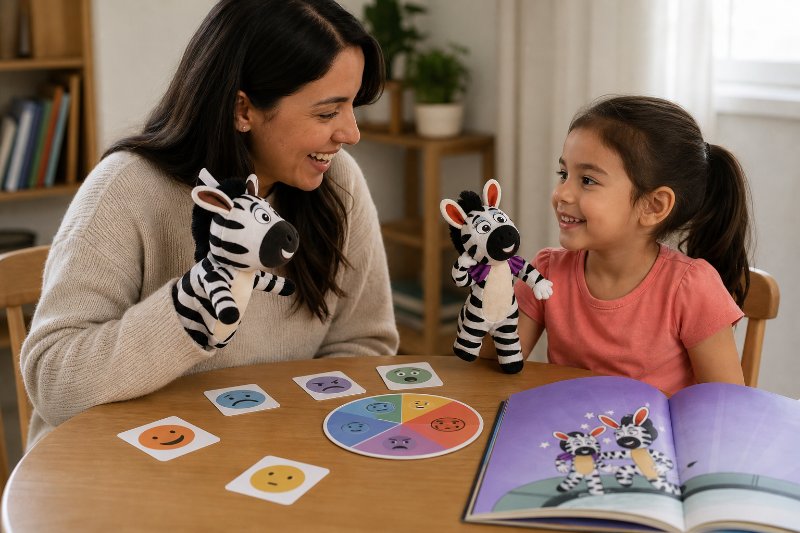
Storytime sticks when children act out, draw, or talk through a character’s feelings after the book ends. Those simple follow-ups turn a picture book into real practice with naming emotions, empathy, and self-expression.
How to Build Emotional Vocabulary Before 5
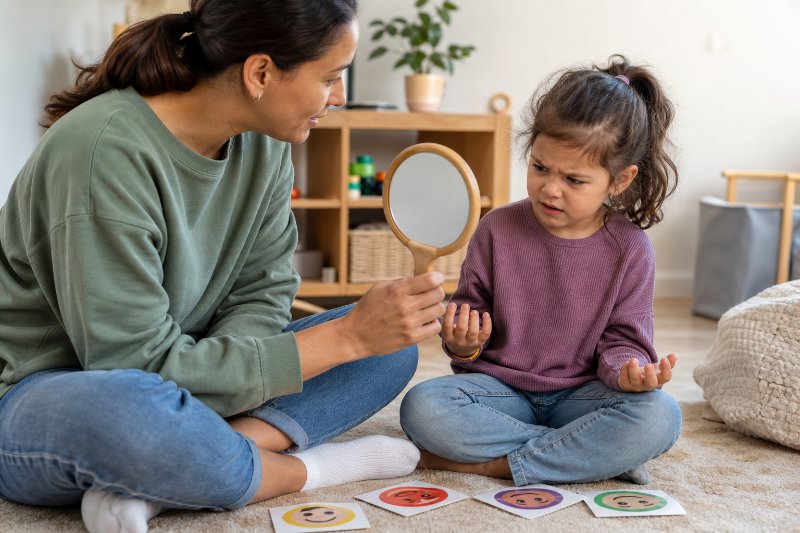
Simple, repeated moments at home, during meals, cleanup, or bedtime, give young children the words for big feelings before those feelings turn into tears, grabbing, or shutdowns.

Social Emotional Learning Books vs. Stories
Stories can give young children the words for big feelings, turning tears, fear, and frustration into naming, calming, and repair. In Portland, social emotional learning books are most useful when they make emotional practice feel safe and familiar.